

3D打印真的跟切割结合在一起了还!!!
2015-01-281.2万

AI 快速预览详细
Scotty项目由Stefanie Mueller开发,通过3D打印和切割技术实现物体的远程传输。该项目使用两台MakerBot Replicator 3D打印机,通过3轴铣床、摄像头和微控制器,逐层切割并传输数据到另一台3D打印机上进行重建。这种方法不仅解决了3D扫描复制的问题,还确保了唯一性和安全性。Scotty项目的未来应用包括电子商务和产品设计领域,为远程传输物体提供了新的可能性。
|
转自3ders.org 原文链接:http://www.3ders.org/articles/20 ... her-3d-printer.html New 3D printer concept 'Scotty' teleports existing 3D objects to another 3D printerYou’ll likely be able to count this among one of the more interesting and philosophical 3D printing applications we’ve ever seen. Stefanie Mueller, a PhD student in the Human Computer Interaction Group at the Hasso-Plattner-Institute in Germany, has developed what is likely to be the closest we’ve ever seen to a teleporting inanimate physical objects across a distance (she also helped develop the WirePrint last year). In staying true to the Star Trek concept, she is calling her teleportation project "Scotty". In theory, one could 3D scan literally any object that is 3D scannable and “teleport” the file to anywhere in the world that has an internet connection to be 3D printed, however that would fall more in line with ‘replicating’ an object rather than teleporting it physically and leaving nothing behind. 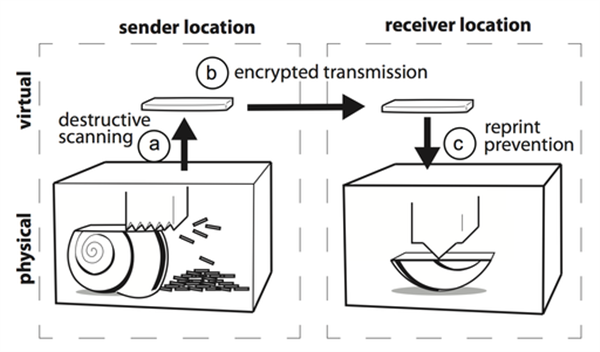 Using two MakerBot Replicator 3D printers, Mueller has been able to successfully destruct an inanimate object at the ‘base’ station using a 3-axis milling machine, a camera and a microcontroller for encryption/decryption and transmission...which was then reproduced on a separate 3D printer layer-by-layer. 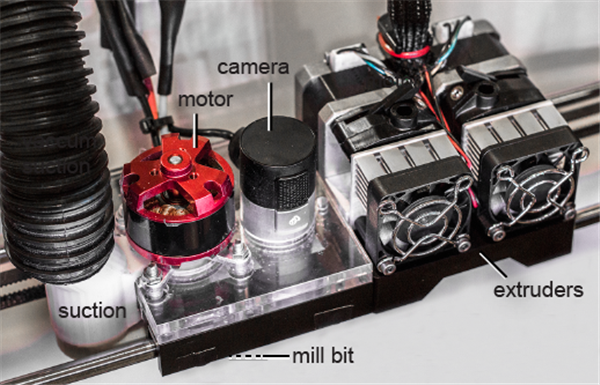 To develop ‘Scotty’, Mueller first had to look at designing a destructive 3D printer. The built-in 3-axis milling machine is programmed to shave off individual layers of material using the same 3-axis mechanism that the MakerBot already uses to move its extruder. While the mill is removing material, it is simultaneously gathering data layer-by-layer in a sort of “reverse-3D printing” method using a down-facing camera that takes a picture after each layer removal. To make it easier for the camera to decipher between the layers, an object is coated with black paint beforehand to better reveal the white layers of its internal structure. Once the picture is taken, Scotty encodes the image in .png format, encrypts it and sends it directly to the other 3D printer in real-time. 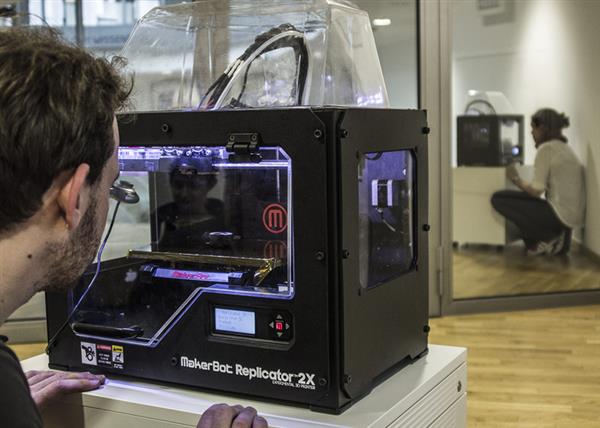 Once the receiver 3D printer recieves the image, it binarizes it and extracts the object contour using the OpenCV connected components algorithm. Once the contour has been extracted, it then triangulates the 2D polygon and generates a 3D mesh of the layer by using the same polygon as the top and bottom surface. Finally, it sends the 3D mesh to MakerBot’s slicer where the data is converted into g-code and finally, 3D printed. 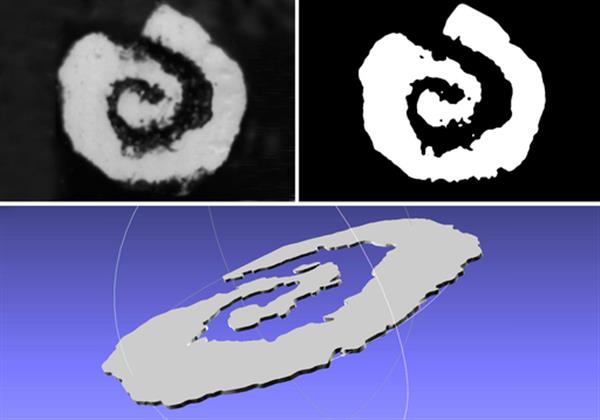 To ensure that uniqueness is achieved throughout the entire teleportation process, Scotty destroys the physical ‘send’ object during the scanning process, the file is encrypted to ensure that it cannot be tampered with and finally, the receiver is only able to make a single copy of the object by maintaining an eternal log of objects already fabricated, which prevents the reprinting of objects.   Among other applications where Mueller sees the future of teleportation is in the future of licensed goods: “Imagine a seller of an online auction site, such as eBay, offers a used copy of the cleverly designed stand for a computer tablet shown in the image below for sale. With instantaneous payment systems such as online banking already in place, the buyer may want to receive the object the very moment he or she completes the auction—by receiving the object electronically and fabricating it locally.” 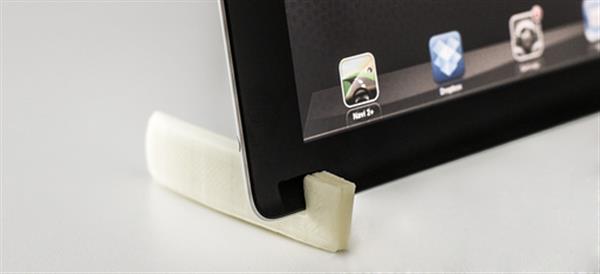 Instead of dealing with complicated copyright and licensing issues that could arise with replicating existing manufactured goods, Scotty addresses the issue of selling a used item by destroying the original while immediately reproducing it for the new buyer. In theory, this could mean that a seller in China could instantly physically “sell” a product design to a customer in Canada without running into licensing issues associated with directly replicating the object via a 3D scan. 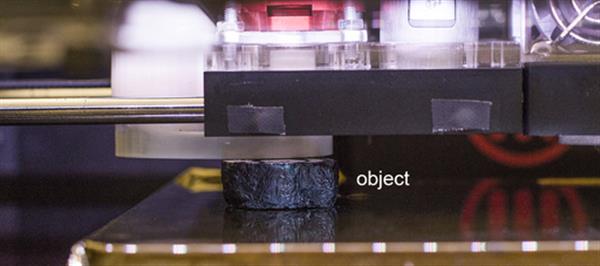 Once the entire teleportation process is outlined, it becomes clear how different the process is from 3D scanning and what it might mean for the future of transporting goods. While a 3D scan or pre-existing 3D model can allow for multiple copies of a single object, Scotty ensures that there are only a set amount of copies that are able to be reproduced. Additionally, the unique method of destruction is capable of not only reading external ‘walls’, but could also theoretically be able to read internal information as well. While we might be a few years off, this could mean information such as circuitry and more complicated engineering details seen in actual functioning product designs. 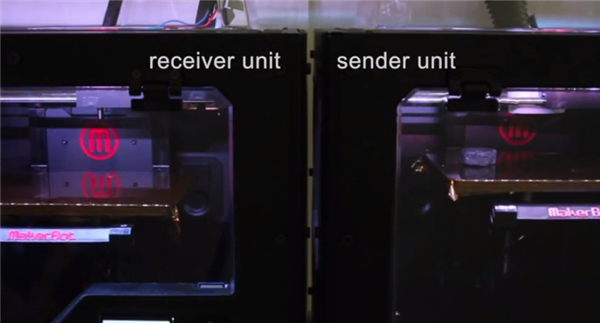  Three couples sent personal handcrafted objects to each other. Since we already have 3D printers that are capable of printing circuitry and complete products such as drones, the concept of teleporting objects from across the world might not be as far off as we think. |
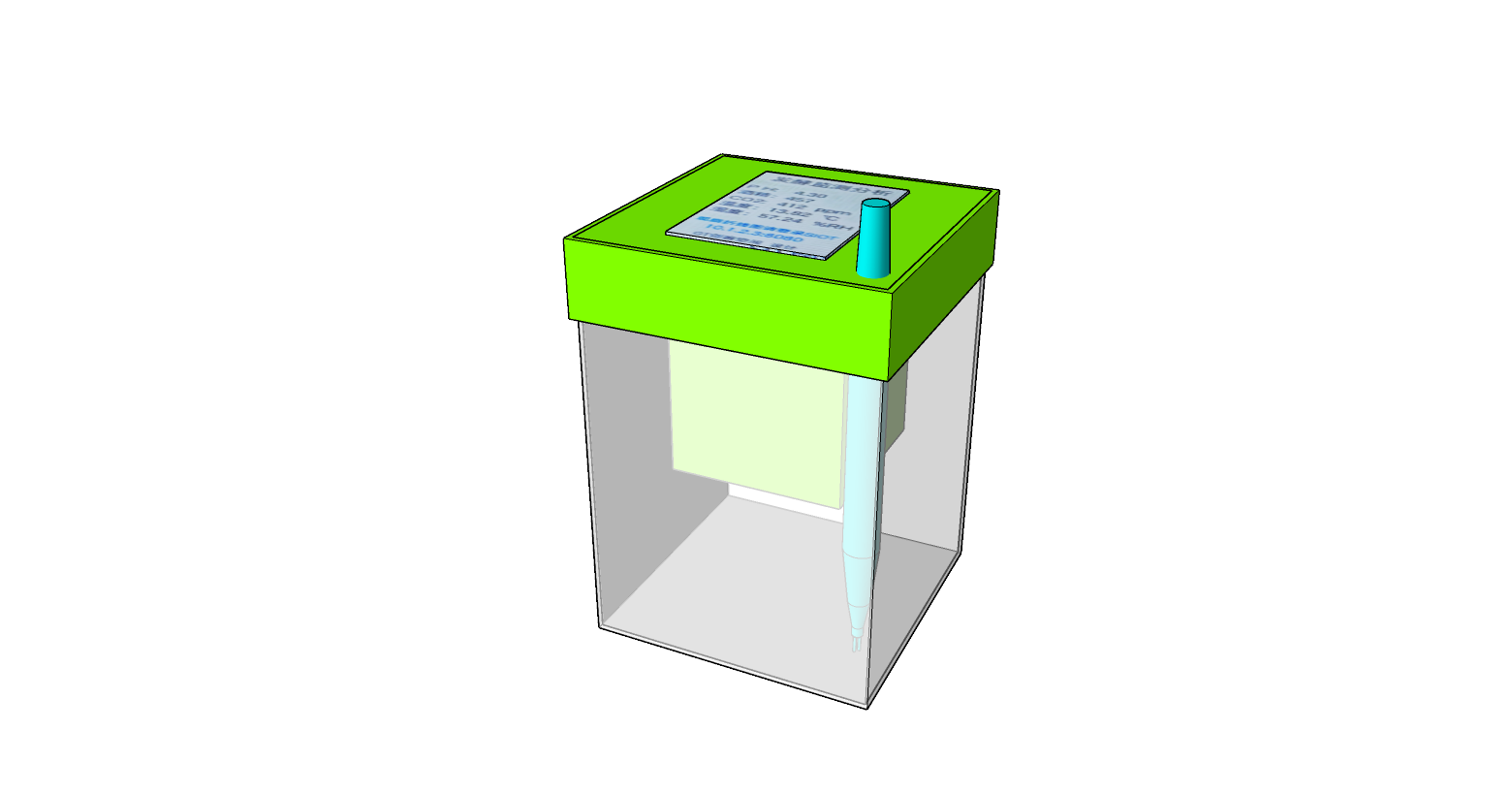

http://www.zhongchou.cn/deal-show/id-10675
WeiBao多功能3D打印机。
台湾一个团队用差不多的创意筹到了300多万美元。