
中证1000ETF量化策略
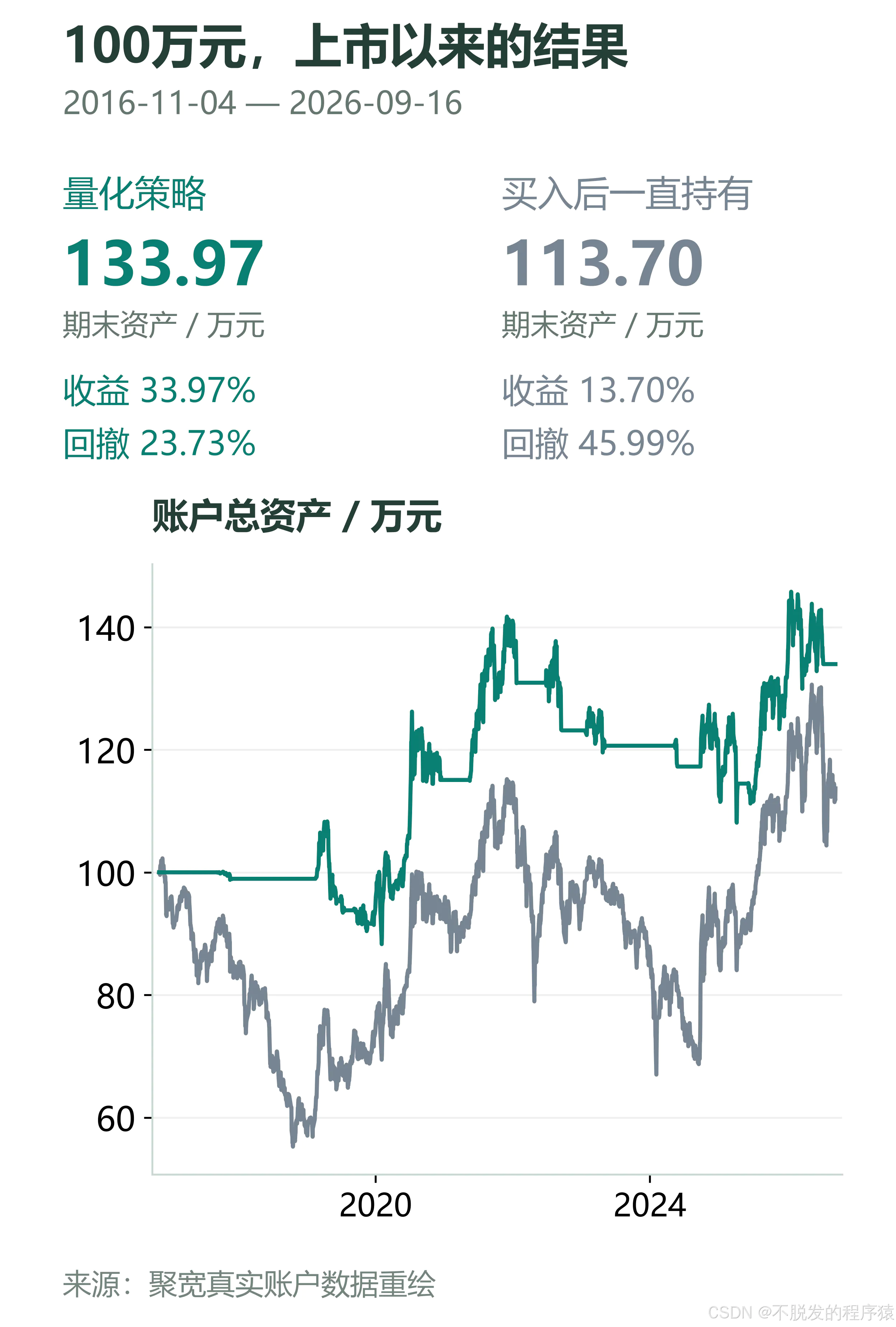
100万元,策略期末133.97万元;买入后一直持有,期末113.70万元。
策略比买入后一直持有多约20.27万元,最大回撤分别为23.73%、45.99%。收益优势是否值得采用,还要看下文成本与邻近参数的结果。
首图由聚宽完成回测后的真实账户数据重绘,采用无损高清图;不是平台界面截图。
1、收益与回撤对比
本篇标的是南方中证1000ETF(512100),聚宽代码512100.XSHG。
回测覆盖2016-11-04至2026-09-16,共2399个交易日,为该ETF上市以来的全部可交易历史。 基金成立早于上市,成立后尚未上市的日期没有场内成交,不能虚构买入。本篇“至今”统一截至2026年9月16日。
| 指标 | 量化策略 | 买入后一直持有 |
|---|---|---|
| 期末资产 / 万元 | 133.97 | 113.70 |
| 累计收益 | 33.97% | 13.70% |
| 年化收益 | 3.09% | 1.35% |
| 最大回撤 | 23.73% | 45.99% |
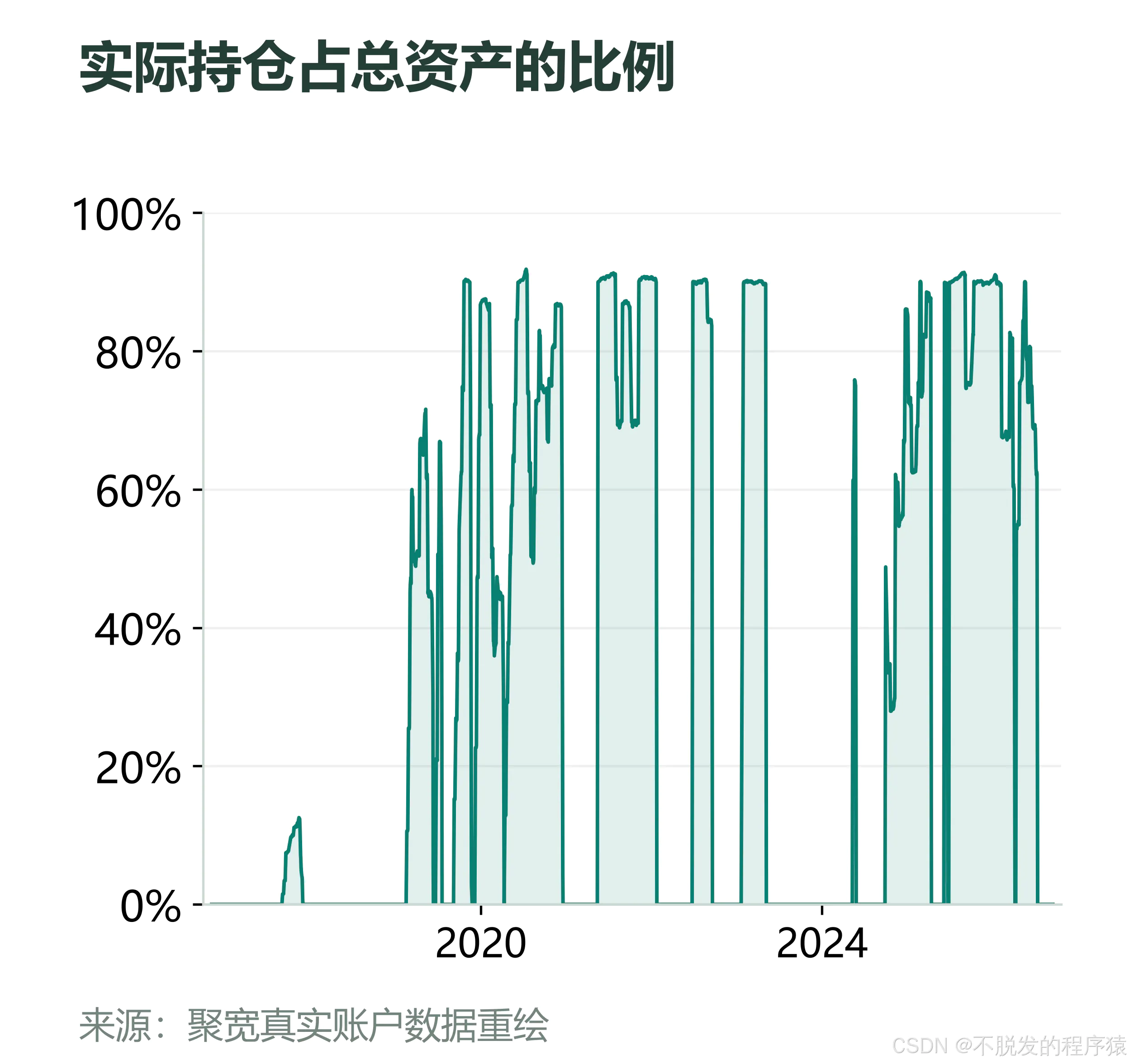
| 平均实际仓位 | 33.56% | 88.24% |
| 有成交的订单 | 141 | 4 |
两组均投入100万元,初次入场预算为总资产的90%,使用相同费用和撮合限制。“买入后一直持有”就是从首个可成交日起完成建仓,此后一直不动,不主动卖出,也不补仓;现金分红留在账户。 它不等于100%满仓或分红即时再投资。
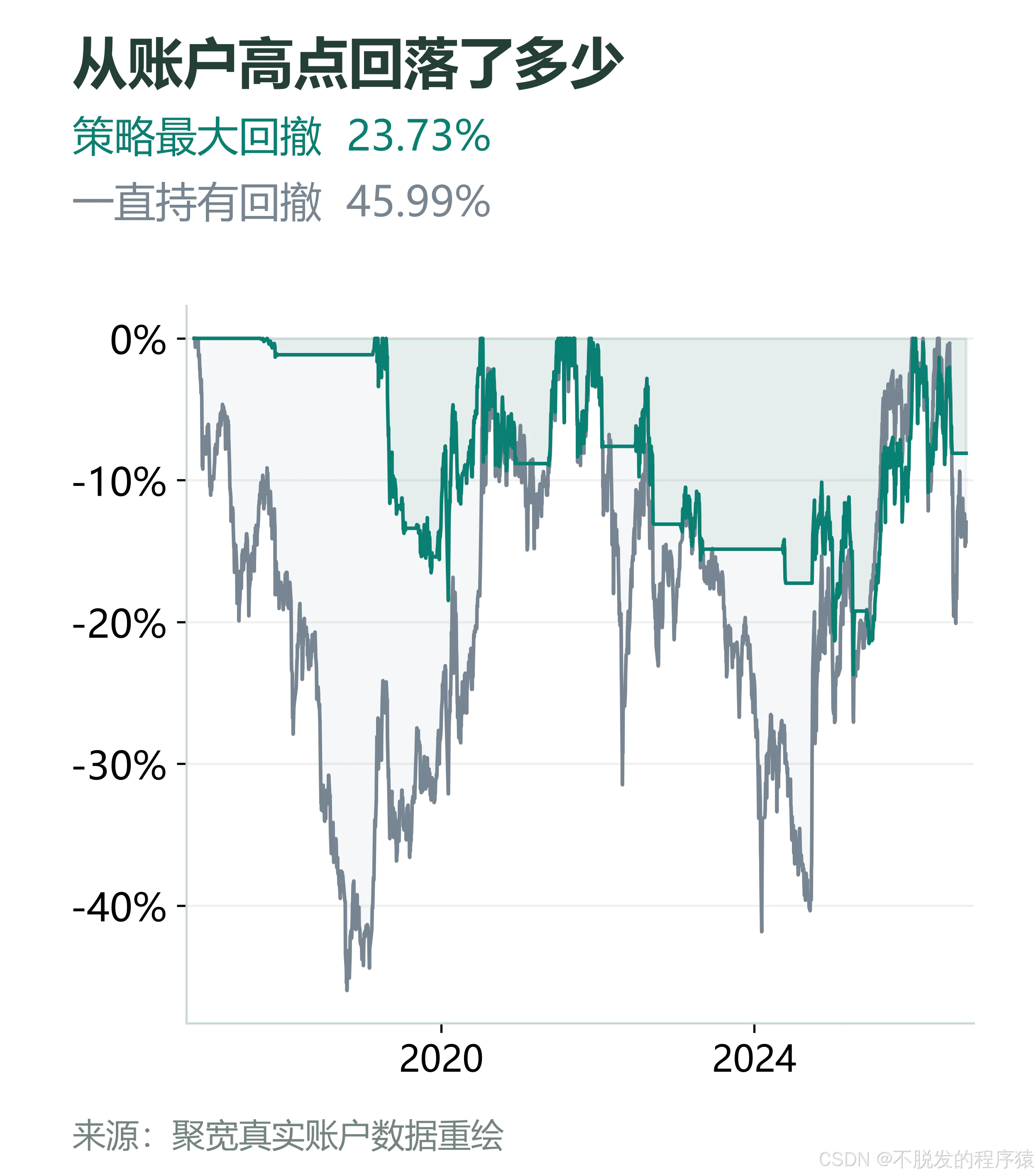
收益包含现金、持仓、分红及已扣费用。最大回撤是账户从历史高点向后的最大跌幅,年化收益沿用聚宽口径;订单可分批成交,不等于完整买卖轮数。图表根据真实账户数据重绘。
本文使用聚宽开发与回测,环境准备可参照基础篇。
2、量化策略的思路与实现
同样持有中证1000ETF,满仓经历30%的波动,与半仓经历30%的波动,账户感受完全不同。
当ETF的历史波动率从20%上升到40%,保持相同仓位会让账户承受更大的波动。本策略用最近20个日对数收益估计年化波动,再用18%的目标波动除以这个估计值,得到参考仓位,最高90%。同时保留120日趋势门槛,避免在长期下跌中仅因波动较低就增加持仓。
| 环节 | 执行规则 |
|---|---|
| 趋势门槛 | 昨收盘高于MA120才允许持仓,否则目标为0 |
| 目标仓位 | min(90%,18% ÷ 20日历史年化波动率) |
| 调仓频率 | 每周首个交易日;实际仓位与目标相差至少5个百分点才调整 |
| 约束 | 不融资、不加杠杆,现金不配置其他收益产品 |
20个日收益需要21个收盘价,波动率采用总体标准差乘√252。18%是计算仓位的风险预算,不是承诺账户实际年化波动一定为18%,也不是最大亏损18%。估计窗口有滞后,跳空发生在减仓之前时,风险可能已经进入账户。
prepare_signal()先读取昨日及更早的已完成行情,strategy_rule()输出目标仓位,execute_signal()在今天提交限价单,close_report()记录实际成交。昨天的信号价,不是今天保证能成交的价格。
实际交易记录
完整历史中,有成交的订单共141笔,完成清仓的持仓阶段14段,累计佣金9210.45元。期末持有现金。
| 完整持仓阶段 | 日期 | 账户变化 |
|---|---|---|
| 最好的一段 | 2025-06-30 至 2026-04-07 | 18.96% / +21.18万元 |
| 最差的一段 | 2022-06-27 至 2022-09-19 | -5.94% / -7.78万元 |
以上从入场前一日算到完全退出,包含期间费用、分红和调仓;不是单笔价差。
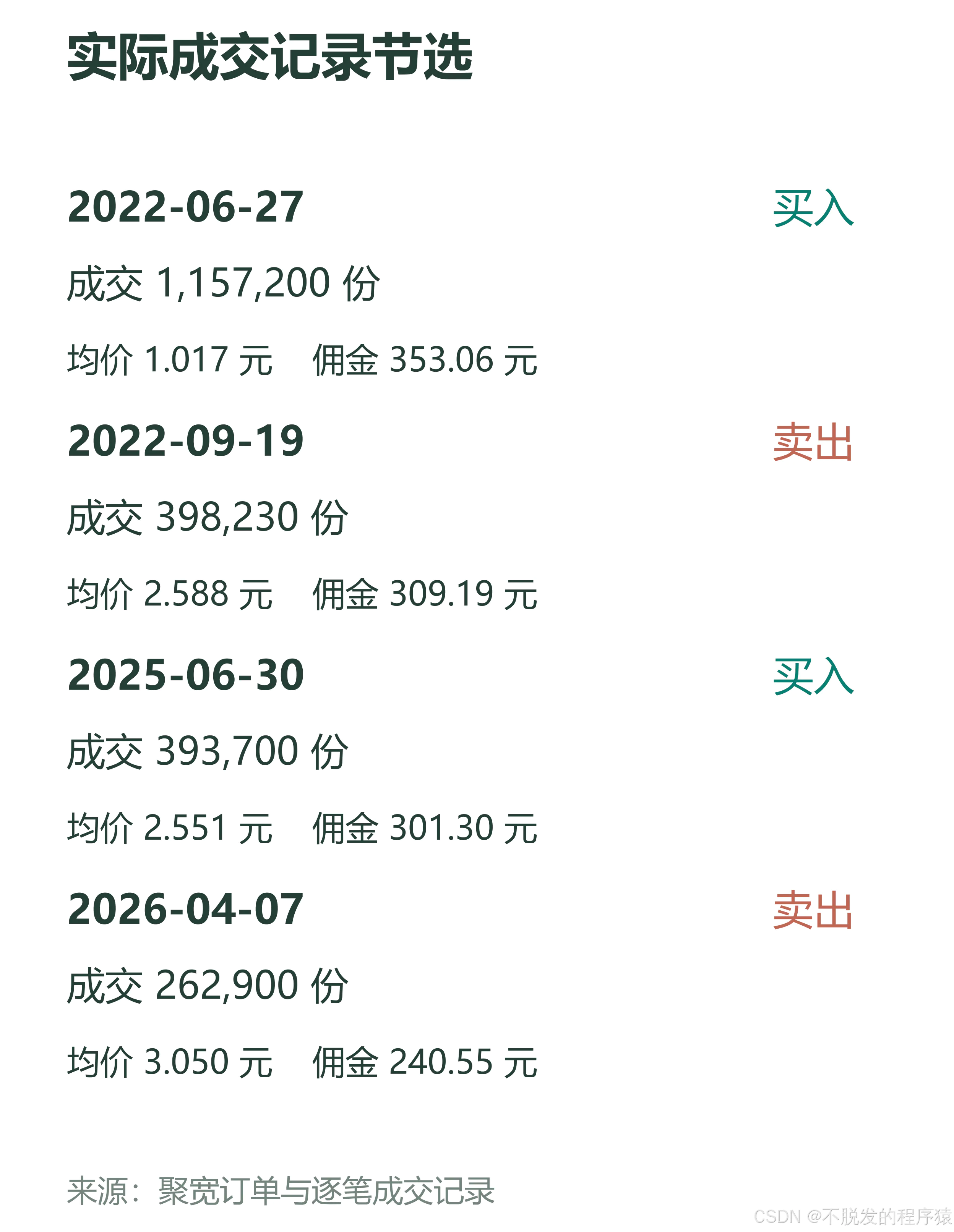
均价来自聚宽逐笔成交的加权汇总,佣金来自订单记录。展示对应阶段首尾交易;没有完成清仓时,展示最早几笔实际成交。
成本与参数检验
| 检验 | 累计收益 | 最大回撤 |
|---|---|---|
| 本文策略 | 33.97% | 23.73% |
| 佣金与滑点翻倍 | 29.02% | 24.45% |
| 取消波动缩放,趋势允许时使用90%仓位 | 47.19% | 21.43% |
| 目标年化波动改为15% | 35.63% | 22.43% |
| 目标年化波动改为21% | 33.42% | 22.66% |
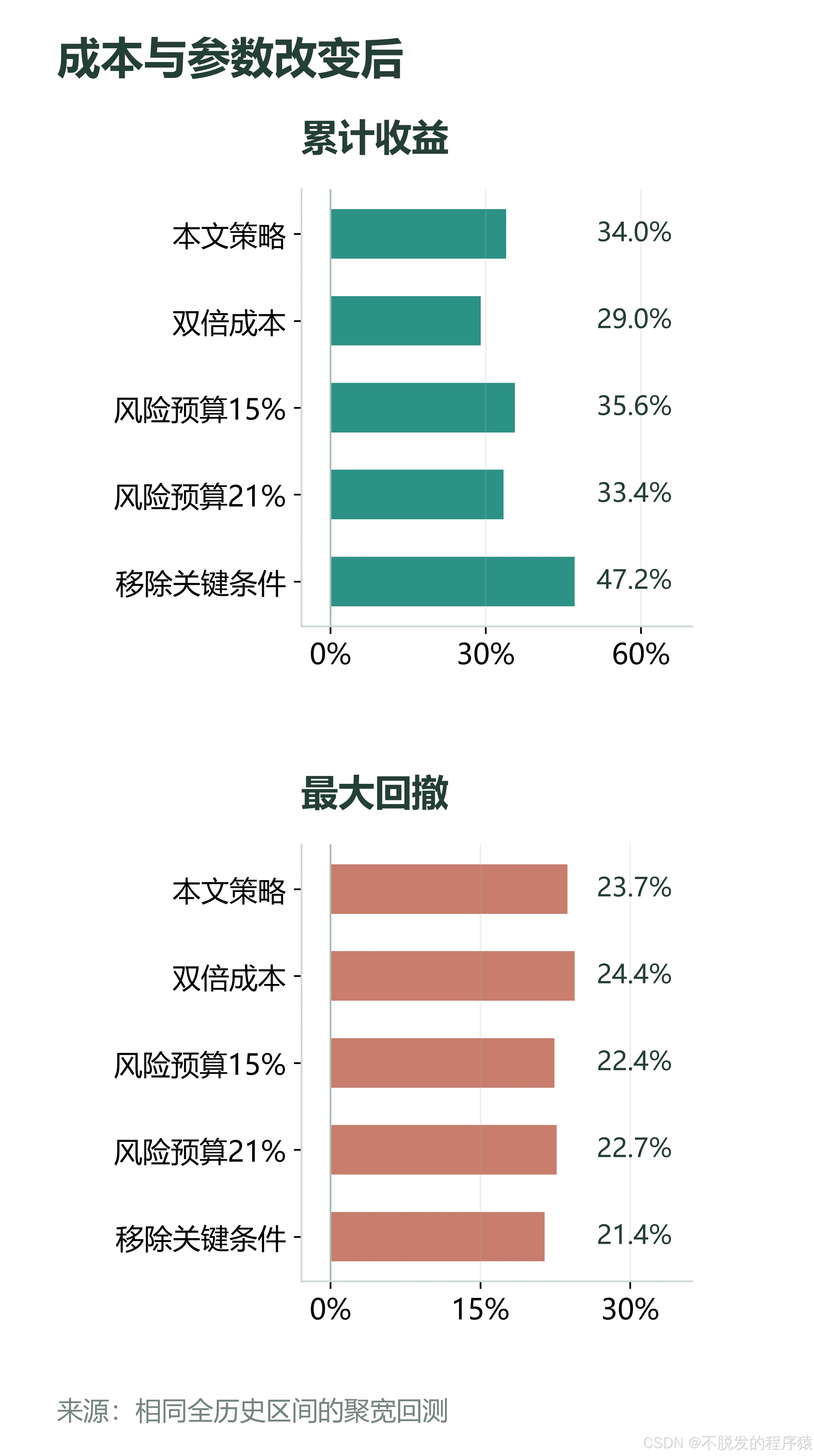
双倍成本后,累计收益为29.02%;两组邻近参数为35.63%、33.42%。三项检验的终值都高于原持有对照。
双倍成本将买卖佣金费率各从0.03%提高到0.06%,最低佣金仍为5元;单边滑点从0.10%提高到0.20%,限价偏移同步从0.2%扩大到0.4%。成交路径可能改变,这属于执行压力检验。邻近检验只改一个参数;没有因为邻近参数赚得更多,就把它换成正文主策略。
下面按时间顺序拆分同一个连续账户,检查收益是否集中在某一阶段;属于回顾性归因。
| 连续账户区间 | 本文策略 | 一直持有 |
|---|---|---|
| 2016-11-04 至 2023-09-25 | 20.66% | -10.39% |
| 2023-09-26 至 2026-09-16 | 11.04% | 26.88% |
按交易日顺序分前70%与后30%;后段继承原持仓和资金,未重新起投。两段收益要连乘,不能相加。
本策略会在周频再平衡时补仓或减仓,现金分红也可能在后续调仓中被投入;“买入后一直持有”对照不补仓,分红保留为现金。这项差异属于仓位规则的一部分。
3、在聚宽复现回测
进入策略回测 → 新建策略 → 空白模版,粘贴第4节完整代码,保存后设置:
| 界面设置 | 填写内容 |
|---|---|
| 起止日期 | 2016-11-04 至 2026-09-16 |
| 初始资金 | 1000000元 |
| 回测频率 | 分钟 |
| 运行环境 | Python3 |
| 策略模式 | 'mode': 'strategy' |
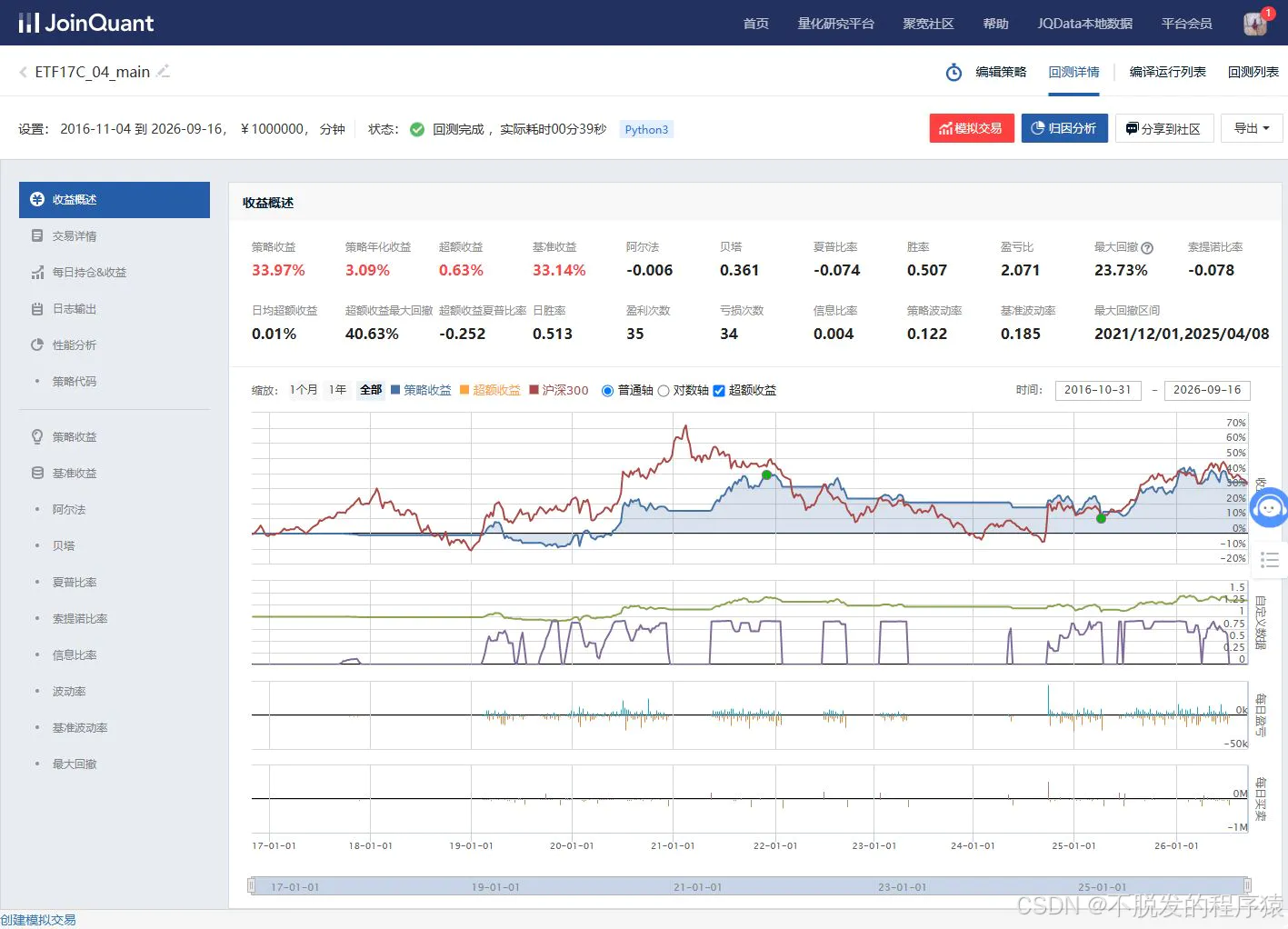
上图为对应主策略的聚宽原始回测截图,包含回测区间、初始资金、完成状态、收益指标及完整收益曲线,未重写平台数字。图中基准线为沪深300;正文“买入后一直持有”对照为另行回测的同一ETF账户,两者口径不同。
程序09:05读昨日日线,10:00提交限价单,10:05撤销余单,15:10记录账户。每周首个交易日产生新决策,界面仍选分钟频率。
本策略需要121个完整日线预热,历史不足时保留现金;预热期仍计入全历史收益。
代码已设定佣金各0.03%、每笔最低5元、基金印花税为0、单边滑点0.10%,按当时分钟成交量1%限制撮合。买入按100份整手提交,实际部分成交可能不是整手;未完成建仓使用原预算续单,按真实成交金额和佣金扣减,未完成卖出继续处理可卖份额。不要把委托成功当成全部成交。
本文按目标仓位再平衡;持有对照不再平衡。这种资金使用差异应结合平均实际仓位阅读。
要复现对照,再复制一份代码,只修改配置中的两项,其余资金、区间、费用不变:
'mode': 'hold',
'experiment': 'ETF17C_04_hold_compare',
运行完成后,核对“收益概述”的累计收益与回撤,再查看“交易详情”“每日持仓&收益”。代码会同时保存每日账户、订单和逐笔成交三
类
记录,文件名前缀由experiment决定;改参数重跑时换一个前缀,便于核对每次结果。
每日记录的cash是可用现金,暂时冻结的资金可能不在其中;核对总资产时,应使用平台账面现金加持仓市值,不能只加可用现金。
这是包含费用与成交约束的历史模拟,尚未接入券商实盘;历史回撤不是未来亏损上限。
4、完整策略代码
复制到聚宽空白策略即可运行。中文注释覆盖参数、信号、预算、限价和真实成交核对。
# -*- coding: utf-8 -*-
"""ETF单品种策略。聚宽Python3,分钟频率,初始资金100万元。

中证1000ETF量化策略:波动越大,仓位越轻。
所有交易信号仅使用前一交易日及更早的数据;真实成交由聚宽撮合。
"""
from jqdata import *
from builtins import all, any, max, min
import csv
import io
import json
import math
import numpy as np

# 中证1000ETF量化策略;南方中证1000ETF。
# mode改为hold可运行买入后一直持有对照;其他参数保持一致。
# frequency是决策频率,回测界面仍选择分钟。params为本文策略指标参数。
CONFIG = {'security': '512100.XSHG',
 'listing': '2016-11-04',
 'mode': 'strategy',
 'params': {'trend': 120, 'vol': 20, 'target_vol': 0.18},
 'warmup': 121,
 'frequency': 'weekly',
 'sizing': 'target',
 'max_weight': 0.9,
 'commission': 0.0003,
 'slippage': 0.001,
 'limit_offset': 0.002,
 'rebalance_band': 0.05,
 'ablation': False,
 'experiment': 'ETF17C_04_main'}

def strategy_rule(h, held, cfg, state):
    """周频风险预算:目标仓位约为目标年化波动/ETF历史年化波动。"""
    p, c = cfg['params'], h.close.values
    if c[-1] <= c[-p['trend']:].mean():
        return 0., '价格低于趋势线'
    if cfg['ablation']:
        return cfg['max_weight'], '取消波动缩放'
    vol = np.std(np.diff(np.log(c[-p['vol']-1:])), ddof=0) * np.sqrt(252)
    return min(cfg['max_weight'], p['target_vol']/max(vol, .01)), '风险预算仓位'


def initialize(context):
    """只初始化一次:资金检查、费用、调度和审计文件。"""
    g.cfg = dict(CONFIG)
    assert abs(context.portfolio.starting_cash - 1000000) < .01, '初始资金须为1000000'
    assert g.cfg['mode'] in ('strategy', 'hold')
    g.state = {'armed': False, 'held_days': 0}
    g.target, g.signal_day, g.attempt_day = None, None, None
    g.pending_exit = False  # 清仓未完成时,次日继续卖出剩余可卖份额。
    g.entry_remaining = None  # 首次建仓的剩余预算,扣实际成交与佣金,不随涨价扩大。
    g.reason, g.source_day = '', ''
    g.out = g.cfg['experiment']
    # 该指数仅供平台画参考线;正式比较另跑同ETF的hold账户。
    set_benchmark('000300.XSHG')
    set_option('use_real_price', True)
    set_option('avoid_future_data', True)
    set_option('order_volume_ratio', .01)  # 1%分钟成交量上限,不是容量保证。
    set_order_cost(OrderCost(open_tax=0, close_tax=0,
        open_commission=g.cfg['commission'], close_commission=g.cfg['commission'],
        close_today_commission=0, min_commission=5), type='fund', ref=g.cfg['security'])
    # 此API参数表示买卖总价差,因此单边0.1%需要传0.2%。
    set_slippage(PriceRelatedSlippage(2*g.cfg['slippage']),type='fund',ref=g.cfg['security'])
    run_daily(prepare_signal, time='09:05')
    run_daily(execute_signal, time='10:00')
    run_daily(cancel_remaining, time='10:05')
    run_daily(close_report, time='15:10')
    write_file(g.out+'_daily.csv',
        'date,total_value,cash,shares,position_value,exposure,target,signal_date,reason\n',append=False)
    write_file(g.out+'_orders.csv',
        'date,order_id,is_buy,requested,filled,price,commission,status\n',append=False)
    write_file(g.out+'_trades.csv','time,trade_id,order_id,amount,price\n',append=False)
    log.info('CONFIG '+json.dumps(g.cfg,ensure_ascii=True,sort_keys=True))


def position_of(context):
    """空仓时返回None;不依赖不存在持仓对象的默认值。"""
    security = g.cfg['security']
    return context.portfolio.positions[security] if security in context.portfolio.positions else None


def is_new_week(today, previous):
    """按自然周比较前后两个交易日,周一休市时周二仍可执行周频规则。"""
    return today.isocalendar()[:2] != previous.isocalendar()[:2]


def prepare_signal(context):
    """先清理昨日信号,再读取已完成日线;失败时不沿用旧的买入指令。"""
    g.target, g.signal_day = None, None
    g.reason, g.source_day = '', ''
    today = context.current_dt.date()
    position = position_of(context)
    held = int(position.total_amount) if position else 0
    if g.pending_exit and held:
        # 已触发的清仓不依赖新的行情窗口;但实际下单仍检查停牌和可卖份额。
        g.target, g.signal_day, g.reason = 0., today, '完成尚未成交的清仓'
        return
    g.pending_exit = False
    if g.cfg['mode'] == 'hold':
        g.target, g.signal_day, g.reason = g.cfg['max_weight'], today, '买入后一直持有'
        return
    if g.cfg['frequency'] == 'weekly' and not is_new_week(today, context.previous_date):
        # 这不是新的周频决策,只是继续执行上次已经批准且未完成的初始建仓。
        if g.entry_remaining is not None and g.cfg['sizing'] == 'entry':
            g.target, g.signal_day, g.reason = g.cfg['max_weight'], today, '继续最初建仓'
            return
        g.reason = '本周非决策日'
        return
    try:
        h = attribute_history(g.cfg['security'],g.cfg['warmup'],'1d',
            ['close','high','low','paused'],skip_paused=False,df=True,fq='pre')
        if h is None or len(h) != g.cfg['warmup']:
            g.reason = '上市后历史不足,保留原仓位'
            return
        # 聚宽可能以缺失值补足上市前的日线,显式归为预热,避免误记为数据故障。
        if str(h.index[0].date()) < g.cfg['listing']:
            g.reason = '上市后有效历史尚不足预热窗口'
            return
        if h.index.has_duplicates or not h.index.is_monotonic_increasing:
            raise ValueError('日线索引重复或无序')
        if h.index[-1].date() != context.previous_date:
            raise ValueError('日线不是上一交易日')
        prices = h[['close','high','low']].values
        if not np.isfinite(prices).all() or (prices <= 0).any():
            raise ValueError('价格缺失或非正数')
        # 窗口中停牌日保留其历史价格;仅最近一日停牌时暂停新信号,避免长期冻结。
        if h.paused.isnull().any() or h.paused.iloc[-1] != 0:
            raise ValueError('停牌字段异常或上日停牌')
        target, reason = strategy_rule(h, held > 0, g.cfg, g.state)
        if not math.isfinite(target) or not 0 <= target <= g.cfg['max_weight']:
            raise ValueError('目标仓位越界')
        g.target, g.signal_day = float(target), today
        g.reason, g.source_day = reason, str(h.index[-1].date())
        if held and target == 0:
            g.pending_exit = True
        if target == 0:
            g.entry_remaining = None  # 新退出或空仓条件撤销尚未完成的建仓预算。
    except Exception as error:
        # 数据故障不是卖出信号。异常日志可用于检查是否被静默跳过了大量交易日。
        g.reason = 'DATA_ERROR '+str(error)
        log.warn(g.reason)


def limit_price(price, high, low, buying, offset):
    """按0.001元报价精度计算限价;涨停不追买、跌停不假定能卖出。"""
    if not all(math.isfinite(x) and x > 0 for x in (price,high,low)):
        return None
    if high <= low or not low <= price <= high:
        return None
    if buying:
        if price >= high-.001:
            return None
        return math.floor((min(price*(1+offset),high-.001)+1e-9)*1000)/1000
    if price <= low+.001:
        return None
    return math.ceil((max(price*(1-offset),low+.001)-1e-9)*1000)/1000


def affordable_amount(budget, price, commission):
    """预算包含佣金;买入必须是100份的整数倍。"""
    if budget <= 5 or price <= 0:
        return 0
    return max(0,int((budget-5)/(price*(1+commission))/100)*100)


def execute_signal(context):
    """10:00下限价单;一次信号最多尝试一次,不把委托成功当成全部成交。"""
    today = context.current_dt.date()
    if g.signal_day != today or g.target is None or g.attempt_day == today:
        return
    security = g.cfg['security']
    if any(o.security == security for o in get_open_orders().values()):
        return
    position = position_of(context)
    held = int(position.total_amount) if position else 0
    entry_only = g.cfg['mode'] == 'hold' or g.cfg['sizing'] == 'entry'
    # 完成最初建仓后,不因价格波动或现金分红补仓;未完成则按原预算继续。
    if entry_only and g.target > 0 and held and g.entry_remaining is None:
        return
    if g.target == 0 and held == 0:
        return
    quote = get_current_data()[security]
    price = float(quote.last_price)
    if quote.paused or not math.isfinite(price) or price <= 0:
        return
    total = float(context.portfolio.total_value)
    exposure = held*price/total
    # 可变仓位模型仅在仓位偏差至少5个百分点时调整,降低小额反复交易。
    if not entry_only and g.target > 0 and abs(exposure-g.target) < g.cfg['rebalance_band']:
        return
    buying = (entry_only and g.target > 0) or g.target > exposure
    lp = limit_price(price,float(quote.high_limit),float(quote.low_limit),buying,g.cfg['limit_offset'])
    if lp is None:
        return
    if buying:
        if entry_only:
            if g.entry_remaining is None:
                g.entry_remaining = total*g.target  # 此轮首次建仓预算只确定一次。
            budget = min(g.entry_remaining,context.portfolio.available_cash)
        else:
            budget = min(max(0,total*g.target-held*price),context.portfolio.available_cash)
        amount = affordable_amount(budget,lp,g.cfg['commission'])
        if entry_only and amount == 0:
            g.entry_remaining = None  # 剩余预算不足100份及费用,确认本轮建仓完成。
    else:
        sellable = int(position.closeable_amount) if position else 0
        # 全清仓允许卖出最后不足一手的剩余份额;减仓则按100份整手计算。
        desired = held if g.target == 0 else int(max(0,held-total*g.target/price)/100)*100
        amount = -min(desired,sellable)
    if amount == 0:
        return
    g.attempt_day = today
    log.info('INTENT '+json.dumps(dict(date=str(today),target=g.target,
        source=g.source_day,amount=amount,limit=lp,reason=g.reason),ensure_ascii=True))
    order(security,amount,style=LimitOrderStyle(lp))


def cancel_remaining(context):
    """撤销本策略未成交委托,次日按新信号或未完成清仓状态重新判断。"""
    for item in get_open_orders().values():
        if item.security == g.cfg['security']:
            cancel_order(item)


def append_csv(suffix, values):
    """逐行保存账户、订单和成交,供独立复算,避免仅凭图中曲线下结论。"""
    buffer = io.StringIO()
    csv.writer(buffer).writerow(values)
    write_file(g.out+suffix,buffer.getvalue(),append=True)


def close_report(context):
    """记录完整资金曲线,包括预热期和现金期;分红和拆分交由引擎入账。"""
    cancel_remaining(context)
    # Order.price可能只反映首笔成交,分批成交须按Trade逐笔累加金额。
    # 同时据此计算成交均价,避免用首笔价格扣预算或展示为加权均价。
    fills = {}
    for t in get_trades().values():
        if t.security == g.cfg['security']:
            amount, turnover = fills.get(str(t.order_id), (0, 0.))
            fills[str(t.order_id)] = (amount+t.amount, turnover+t.amount*t.price)
            append_csv('_trades.csv',[str(t.time),str(t.trade_id),str(t.order_id),t.amount,t.price])
    for o in get_orders().values():
        if o.security == g.cfg['security']:
            amount, turnover = fills.get(str(o.order_id), (0, 0.))
            assert amount == o.filled, '订单成交量与逐笔成交不一致'
            average_price = turnover/amount if amount else 0.
            append_csv('_orders.csv',[str(context.current_dt.date()),str(o.order_id),
                bool(o.is_buy),o.amount,o.filled,average_price,o.commission,str(o.status)])
            if o.is_buy and o.filled > 0 and g.entry_remaining is not None:
                g.entry_remaining = max(0.,g.entry_remaining-turnover-o.commission)
    p = context.portfolio
    position = position_of(context)
    held = int(position.total_amount) if position else 0
    value = float(position.value) if position else 0.
    if held:
        g.state['held_days'] += 1
        g.state['armed'] = False
    else:
        g.state['held_days'] = 0
    record(account_nav=p.total_value/p.starting_cash,exposure=value/p.total_value)
    append_csv('_daily.csv',[str(context.current_dt.date()),p.total_value,p.available_cash,
        held,value,value/p.total_value,g.target,g.source_day,g.reason])
中证1000这一篇把风险预算转换成仓位,而不是把目标波动写成收益承诺。判断它是否有用,需要同时看资产增长、回撤、平均仓位和再平衡成本;只有这些数字一起改善,仓位控制才具有实用价值。